10 March 2009

Do you like your face?


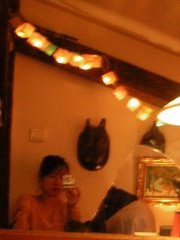
This month Focus is dedicated to the relation between one's face and one's identity. While I was preparing the issue, I randomly shot quick takes of some of my co-workers and friends asking them if they like their face, which part they prefer, which part they don't like etc... It was quite fun to do it and to edit it, despite some technical problems due to the fact that I interviewed some of them with my photo camera... Most of all, I think that it reveals somehow some aspects of their very different personalities - I even discovered that some of my friends are born-actors!


I hope that you have fun watching this video:


(Photo by Wen-chun Kuan, see her presentation and her flickr)

5 March 2009

"Ready to talk peace"

A catchy and strange title for this article on Reuter's webpage: China says ready to talk peace with Taiwan... But at the end it seems like there is still a balance to be found between political and economical necessities.

3 March 2009

Mon Visage, Moi (extrait de la lettre du mois de mars)


Est-ce mon apparence qui me définit en premier ou est-ce plutôt l’inverse ? Aussi notre Focus intitulé « Mon Visage, Moi » porte-il une touche très féminine ce mois-ci. Diverses contributrices nous présente d’une manière esthétique leur conception du lien entre identité et apparence : Aimée Hsu est peintre et maîtrise aussi l’art du maquillage, elle nous décrit ici l’art d’appliquer des couleurs sur un visage. Aurélie Kernaléguen est allée enquêter sur la chirurgie esthétique à Taïwan tandis que Wen-chun Kuan nous fait partager l’intimité de ses autoportraits photographiques. De son côté, Alice Lin se demande si la beauté est mathématique et constate que les apparences sont souvent trompeuses quand il s’agit des jeunes asiatiques d’outre-mer.

Pour vous, eRenlai s’efforce de mettre en ligne régulièrement de nouvelles créations vidéos : chaque semaine, nous vous invitons à visionner notre commentaire sur la homepage. Parmi nos éditoriaux du mois de mars, nous vous proposons de courtes vidéos rapportées d’un village situé dans la province du jiangxi en Chine : pourquoi ne pas démarrer avec Good morning Changxi village! ou Le Forgeron ? En outre, ne manquez pas le récit du prêtre Jésuite Andres Diaz de Rabago âgé maintenant de 92 ans et ayant vécu en Chine, aux Philippines, au Timor Oriental et à Taïwan. D’autres vidéos, articles et animations Flash abordent les sujets de l’enseignement des langues ou le décès récent du maître bouddhiste Sheng Yen.

My Face, Myself - eRenlai March 09 newsletter


Dear Friends,

Are our appearances meant to define our identities, or vice-versa? There is a feminine touch in our Focus this month entitled “My Face, My Self”. Contributors share their approach on the relation between identity and appearance through aesthetic concepts: Aimee Hsu is a painter and a make-up artist, she describes the art of colors in “My Face, the canvas of my life”. Aurelie Kernaleguen provides us with a report on eyelid surgery in Taiwan. Wen-chun Kuan shares with us her intimate journey into self-photography. Alice Lin wonders about the mathematical equation of beauty and how appearances can be tricky when it comes to the overseas Asian youngsters today.

As you know, eRenlai uploades multimedia features on a regular basis; don’t forget to check our weekly commentary on the homepage. In our March editorials, watch short videos brought back from a village in Jiangxi Province: start with Good morning Changxi village! or The Blacksmith.
Also read and watch an exclusive interview with 92-year-old Spanish Jesuit priest Fr Andres Diaz de Rabago, who has lived in China, the Philippines, East Timor and Taiwan. Other videos, flash animations and articles broach subjects such as language education and Buddhist Master Sheng Yen who passed away in January.

Finally, we would like to thank you for your encouragements and the positive feedbacks we have received regarding eRenlai’s new layout. Nevertheless, we know that the new version has had some technical problems and we apologize for it. If you still encounter troubles in entering or opening our website pages, you can either try clearing your browser cache or pressing F5 to refresh your browser.

We wish you a great month ahead,

Who wants to be a Slumdog millionaire?

I didn't expect Slumdog Millionaire to win the Best Picture Oscar and even less to win 8 Oscars at all! Before the Oscar ceremony I had only seen the trailer and it is Alice, my colleague, who announced me the results last week. We decided then to film a short commentary about it (watch it here).
After watching the movie last week-end, I understand better how it can be an oscarized movie despite its relatively low-budget and its absence of famous actors from the US film-industry: the plot, a success-story with a happy-ending, is still quite hollywoodian, the characters and especially Jamal, the main hero, are manicheistic enough to be recognized as "types" (the naive and idealistic one, Jamal, the cynic who redeem himself, Salim, the beauty, innocent but pushed by social and economic imperatives, Latika). Even the non-linear construction of the narration does not seem that original after one hour... (for a maestro piece of cinema, in editing and narrative terms, see Valkyrie, which, in my sense is not a historical movie but a successful suspense exercise in cinema).

Still, I cannot say that I didn't like watching the movie, I did feel a bit irritated by the predictable nature of the end but the movie is enough entertaining and meaningful to be recommended and, probably, awarded!


11 February 2009

Le carnet magique de Tafalong


L'an dernier, j'ai participé à la réalisation d'un documentaire se déroulant dans un village aborigène situé sur la côte Est de Taiwan. Cette expérience a été pour moi l'occasion de mieux connaître une partie à la fois géographique et culturelle de l'île. Taiwan reconnait en effet officiellement 14 peuples aborigènes dont celui des Amis, mais on ressent relativement peu leur présence à Taipei. L'expérience entière mérite plus qu'un simple post de blog (et fera d'ailleurs peut-être l'objet d'un récit plus long), je vous laisse d'abord "feuilleter" le site créé par Nicolas Priniotakis (en charge de notre nouveau département audiovisuel) et cliquer sur les liens mentionnés dans l'extrait de la newsletter de décembre ci-dessous:

http://erenlai.com/tafalong/

(Lettre de Décembre)
Tafalong est habité par le peuple Amis, l’un des quatorze groupes aborigènes de Taïwan. Nous avons suivi pendant toute cette année une jeune femme Amis, Nakao Eki, qui pour la première fois en neuf ans est retournée dans son village : de cette expérience, nous avons tiré un film documentaire, intitulé « On the Fifth Day, the Sea Tide Rose* », et dont vous retrouverez certains moments forts ce mois-ci sur notre site. Vous pourrez notamment y découvrir une nouvelle manière de narrer et d’écouter l’histoire orale des peuples aborigènes d'Asie.

Le grand-père de Nakao chante un air ancestral qui raconte les origines du village de Tafalong : Tafalong a niyaro.

Un autre personnage important du film est Haruko, la tante de Nakao, qui a perdu récemment l’un de ses fils. Elle et ses petites-filles revêtent ici les costumes traditionnels Amis pour entonner un dernier chant d'adieu avant le “Ilisin”, une fête durant laquelle les hommes de la tribu dansent en mémoire du fils décédé d’Haruko.

Soyez le témoin d’un spectacle insolite : des femmes âgées de Tafalong se réunissent chaque semaine dans la cour de l’église catholique et font revivre leur enfance par l’intermédiaire des kimonos qu’elles portent et des comptines qu’elles chantent, dans un mélange de religiosité et de divertissement.

Alice


As comments made about articles on eRenlai cannot appear directly on the website, I post below a comment we received a couple of weeks ago about an article written by Alice Lin. This is also the right time to introduce Alice: she has started to work for eRenlai as our English editor since December. Born in Taiwan, she has grown up in Namibia and lived in a lot of different countries including New Zealand, Singapour, France and Morocco. She recounts her numerous travels in her article Down with Zugunruhe which triggered the reader's comment below. Alice has many talents among which singing in !Xhosa, also listen to her and her friend Brenda here.

------------------------------------------------------------------------------------


This article is an extremely interesting testimonial. It reminds us that nomadism is an interesting and vast subject, as much of the past as of the future; discussing this subject may act as a valuable catalyst, may bring new ideas, even inspire new fields of research -at least in my case-... It is the second time in recent years, and from a very different angle, both apparently very important in terms of sociology, that I hear about 'nomadism' as a key subject, worth deeper analyses. Here with Alice Lin it is the angle of 'animal migratory behavior', engrained in the genes of a few species or individuals. The first time it was a more futuristic, theoretical and sociological angle. It was in browsing through the book "Une Brève histoire de l'avenir" (Paris Fayard 2006) by Jacques Attali (see his bilingual site www.attali.com). Very roughly the well-known and very prolific French essayist Attali describes the future, in a few decades, as an increasingly unified small planet where dominate two main social classes, the nomads (the 'higher', better educated and richest class) and the others, the (more) sedentary people. Whatever one may think of Attali's works and personality, I just discover here in checking this reference that he wrote a more precise book on the subject of human nomads, which I didn't read yet, "L'homme nomade", Paris Fayard 2003 (I didn't check translations of his books in other languages). Besides, amongst other ideas popping up in my mind with the term 'nomadism' right now, there is, with cheap flights and Internet, the link with this other important subject (one of my pet subjects) the possibly worrying 'acceleration of history', directly related to the growing size, complexity, but also interlinkage and unification, of the human society, due to technology (even if history repeats itself ...probably because the human body and brain doesn't evolve at all at the same pace than human society and technology -like nothing new with nomadism since the Paleolithic and probably in a thousand years through galaxies !-; ... thus human history may seem to be accelerating like a point moving along a spiral, towards -or away from ?-, a kind of noosphere or omega point !).Other ideas are popping up: the growing and bumpy disappearance of the concept of nation and/or state (especially in light of the present world economic crisis -the present sudden return of the nation-state is just a in my view reflex bursts of slowly dying complex bodies, for which wars and guns still unhappily remain the ultimate solution-), and thus the obvious necessity of a wider and better world governance of our small 'planet-village',...; on the opposite, the necessity somewhere in the genes of some living species -especially h. s. sapiens - of a 'home', of the German concept of 'heimat', a 'nest' where to grow up quietly and safely, where to acquire memories, an education, a conscience... The theme of 'nomadism' is also indeed linked to the subjects of education, languages and cultures, religions, family, friends and social links, freedom (of movement)(itself linked to the concept of democracy; where do I vote if I am a nomad ?, should I or can I if need be 'vote with my feet' ?), etc. etc.Besides, it was my first time on erenlai.com; congratulations for this site.


Arthur Syel

-------------------------------------------------------
Down With Zugunruhe

21 January 2009

Prédictions pour l'année du bœuf

L'année du bœuf commence samedi. Qu'elle vous soit propice !
Sur eRenlai vous trouverez un édito vidéo en français de Benoît Vermander qui se risque à émettre trois prédictions pour la Chine au seuil de cette année.

http://www.erenlai.com/index.php?aid=2184&lan=3

26 November 2008

Le travail, c'est la santé


Depuis que je me suis inscrite à un club de gym, je suis devenue une vraie loque. Trois fois par semaine, je quitte mon bureau et traverse la rue pour me rendre dans un centre sportif portant le nom d'un état ensoleillé des Etats-Unis (dix balles pour celui ou celle qui trouve). On pourrait d'ailleurs s'étendre longuement sur le nom choisi, évocateur de jeunes surfeurs bien balancés, aux dents éclatantes de blancheur pour mieux contraster avec le bronze de leur peau. Mais dès qu'on pénètre dans les lieux, c'est une toute autre chanson qu'ahanent les sportifs en salle: vêtus de leurs plus beaux survêts, ils s'acharnent sur des machines électroniques qui affichent des coeurs, des losanges et des rythmes cardiaques. C'est la foire à la montre, à qui arbore les plus gros biceps et les plus larges auréoles de sueur. C'est la souffrance et l'effort qui font la loi et moi-même j'avoue m'être prise au jeu bien que je n'aie pas -encore- poussé le vice à m'affubler de la tenue complète : je n'ai ni les baskets de marque, ni les petits gants pour soulever les haltères. Etant nouvellement inscrite, on m'a, par contre, gentiment accolé un " personal trainer" qui essaye à tout prix de me motiver à acheter des séances d'entrainement privé. Après m'avoir longuement expliqué que je j'ai du gras partout et du muscle nulle part, mon "personal trainer" met mon petit corps chétif à rude épreuve et voilà trois jours que j'essaye de m'en remettre, la seule position qui ne fait pas souffrir quand je suis debout étant celle du golfeur constipé, à savoir : le dos légèrement voûté et les fesses en arrière... Fort heureusement, je ne sens presque rien quand je suis assise à mon bureau devant mon écran d'ordinateur, je suis donc toujours apte au travail.


"Le travail, c'est la santé", comme chantait l'autre, "rien faire c'est la conserver, les prisonniers du boulot font pas de vieux os..." (Henri Salvador)


Je signale à ce sujet un petit article posté sur le site http://china-crossroads.com/ : Why China’s Economic Rise is Unhealthy, (Pourquoi l'essor économique de la Chine nuit à la santé) dans lequel l'auteur évoque brièvement les heures de travail et le rythme de vie frénétique auxquels sont astreints les cols blancs en Asie, expats compris. 80 à 100 heures de travail par semaine arrosées d'une bonne dose de café, d'alcool et de tabac car l'on se détend le soir et le week-end dans les boîtes, lounge bars et karaokés... Et pour se déculpabiliser de tous ces excès, on finit ensuite la semaine par une petite séance de tapis roulant! Pour ma part, mon club de gym aura eu ma peau, je ne suis plus bonne à rien ces temps-ci, j'ai même récemment abdiqué devant mes courbatures, refusant de boire une bière avec des amis pour rentrer chez moi m'affaler sur mon canapé et regarder des jeux télévisés japonais...


-----------------------------------------------------

Aurélie Kernaléguen (auteure de la photo) a réalisé l'interview d'un adepte du body building à Taiwan:


Le sport, le sang et la sueur (je m'exprime en vrac sur les joueurs de rugby français, le football féminin à Zanzibar)

10 November 2008

The hour of truth


On November 6, Ma Ying-jeou, the president of Taiwan met Chen Yun Lin, the chairman of the Association for Relations Across the Taiwan Strait (ARATS). It is an historic moment for the cross-strait relations as it has been 60 years since a Chinese dignitary of this rank came to the island.

Benoit Vermander comments on the events that occurred during the visit
http://www.erenlai.com/index.php?aid=2030&lan=3

(Photo taken from The Chinapost )

 
Clicky Web Analytics